Activist stories: What if they are wrong? Who decides?

There's something I’ve really struggled with in activism: the choice to focus on what is wrong or broken seems to be a double edged sword. It can help fix things but I’ve also found the flavor of the work discouraging, particularly in cumulative effect. What’s hardest for me is not the turning toward suffering — that’s hard work but good work and I feel decent at it. What’s really hard is the habit of finding whatever is still wrong, the feeling that admiring any flawed human institution would amount to a kind of betrayal — a tacit endorsement of, or even a kind of participation in, those very flaws.
American history, one story at a time
For instance: Was the founding of this country admirable? Many of the People I Read on the Internet don’t seem to think so. And the story America has told itself about its founding has relegated slavery to a sideshow, and ignored the genocide of native peoples.
Along with those horrors, we have the Constitution’s ideals, and the Fourteenth Amendment, and suffrage and prosperity. We’re the most diverse and richest country in the history of the world, and far and away, the favorite destination of those abroad who seek a better life. The founders, whatever else they did, planted seeds that generations of Americans have cultivated and harvested into that sweet fruit. A story that doesn’t have that in it — not unlike the story without all the oppressions — is incomplete.
But it’s sort of hard to cram both of those into just one story. Maybe stories can never be "complete" in quite that sense. People are endlessly complicated, but stories have one plot. Perhaps it’s not fair to ask today’s activists — famously including the 1619 Project and its associated curricular resources for history teachers – to cover all sides. The project was named for the year in which the first African slaves arrived in the colonies, and Nikole Hannah-Jones wrote in its introductory essay that “one of the primary reasons some of the colonists decided to declare their independence from Britain was because they wanted to protect the institution of slavery.” A historian the Times consulted to fact-check this and other claims said otherwise, and later, a quartet of prominent American historians issued a sharply critical letter (claiming that the project “ contains significant factual errors and is driven by ideology rather than historical understanding”), which likewise zeroed in on the claim that slavery motivated the American colonists to declare independence.
There were many founders, and many motives — the essential disagreement, it seems, was about which story to tell. As Adam Serwer writes:
The clash between the Times authors and their historian critics represents a fundamental disagreement over the trajectory of American society. Was America founded as a slavocracy, and are current racial inequities the natural outgrowth of that? Or was America conceived in liberty, a nation haltingly redeeming itself through its founding principles? These are not simple questions to answer, because the nation’s pro-slavery and anti-slavery tendencies are so closely intertwined.
The letter is rooted in a vision of American history as a slow, uncertain march toward a more perfect union. The 1619 Project, and Hannah-Jones’s introductory essay in particular, offer a darker vision of the nation, in which Americans have made less progress than they think, and in which black people continue to struggle indefinitely for rights they may never fully realize. Inherent in that vision is a kind of pessimism, not about black struggle but about the sincerity and viability of white anti-racism. It is a harsh verdict, and one of the reasons the 1619 Project has provoked pointed criticism alongside praise.
It’s maybe impossible, or maybe just really, really hard, to tell both of these stories at the same time, to hold room for it all. Both the record of a slow march toward a more perfect union, and the very ugly realities not only of history, but of stalled progress now, and uncertainty about how much of this oppression we can ever really be rid of.
I fear I was wrong about policing.
To take another example, closer to my own work, consider a present-day race and justice debate, namely that of police violence. I’ve worked on these topics for years — pushing back against racially biased “predictive policing” algorithms; fighting “threat score” systems that seem destined to motivate more lethal force; and opposing courtroom systems that amplify old fears and send people to cages. Over that time, a growing number of my colleagues and friends have come to self-identify either as “abolitionists” or as, at least, advocates of an invest-divest framing, where money gets subtracted from police budgets so that it can be added to social services. I myself think police budgets are bloated, that bad behavior by police is not nearly as rare as we might like to imagine, and that punishment of such bad behavior is very rare. The pretrial part of the criminal law, where people are routinely jailed and lives upended based on accusation rather than proof, seems to me the worst part of all this.
And yet: I was part of a class of woke activists in DC and other large cities, most of whom graduated from to college and write things all day, and most of whom neither grew up nor live now in the low income communities of color where most of the violence, police-inflicted and otherwise, actually happens. I’m white and economically comfortable, which put me further from this ground than some of my colleagues, but in truth, few of us were speaking firsthand about our own block or our own friends facing violence.
How can I know that the people most impacted by bad policing — and at the same time by the gang and other violence that police are tasked to address — actually wanted the policy remedies that my colleagues and I were advocating?
There have been a couple times recently when data that doesn’t fit the story we told has sort of hit me upside the head.
Item one: Last summer, in the midst of national protests on police violence, 81% of African-American respondents in a national poll told Gallup that the police presence in their own neighborhood should be maintained or increased. That doesn’t mean these respondents liked how police work in their neighborhoods. But it also doesn’t suggest support for deep cuts to police budgets — much less abolition of police departments.
Item two: the NY Times’ detailed, interactive map of results from the New York City democratic mayoral primary, which took place in June. If you didn’t follow the race, I’ll summarize by saying that Maya Wiley (in gold) was the social justice candidate, who was strongest in favor of woke police reform; Kathryn Garcia (in green) was a sanitation commissioner and good government type who promised to focus on service delivery issues; and Eric Adams (in purple) is a former policeman who promised to focus on restoring law and order, and who neither supported nor appeared to sympathize with defunding or abolishing police.
Adams won the primary, and seems assured to win the mayoral race this fall. But what surprised, bothered and fascinated me was how he won: by carrying the poorest, most nonwhite parts of the city. Here's a map of Astoria, the neighborhood in Queens where I used to live:
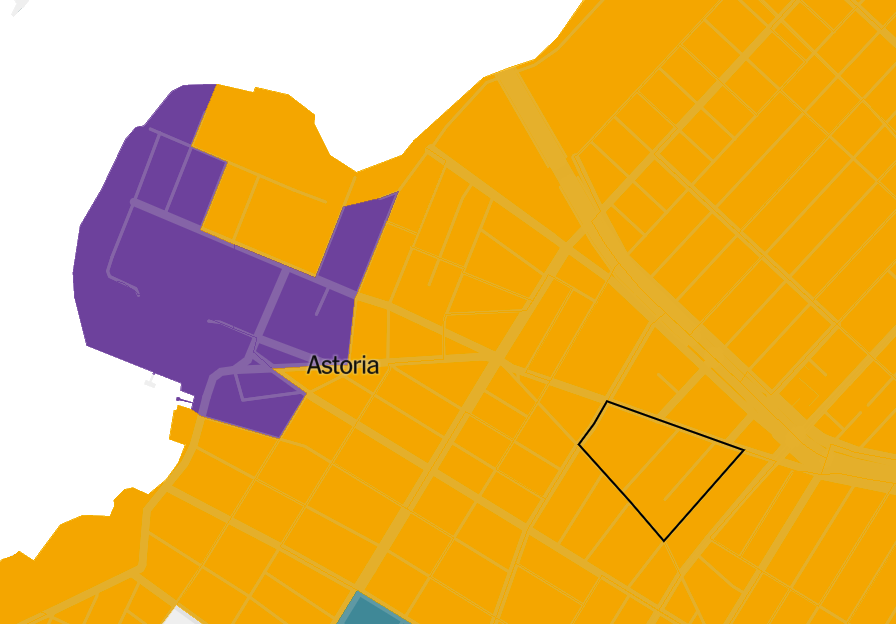
It's a mixed neighborhood of second-generation Greek and Arab Americans with a growing number of gentrifying yuppies such as myself, and went mostly for Wiley. But that purple zone near the river? That's the Astoria Houses, a city public housing project, whose residents are mostly Black and have incomes low enough to qualify them for housing assistance.
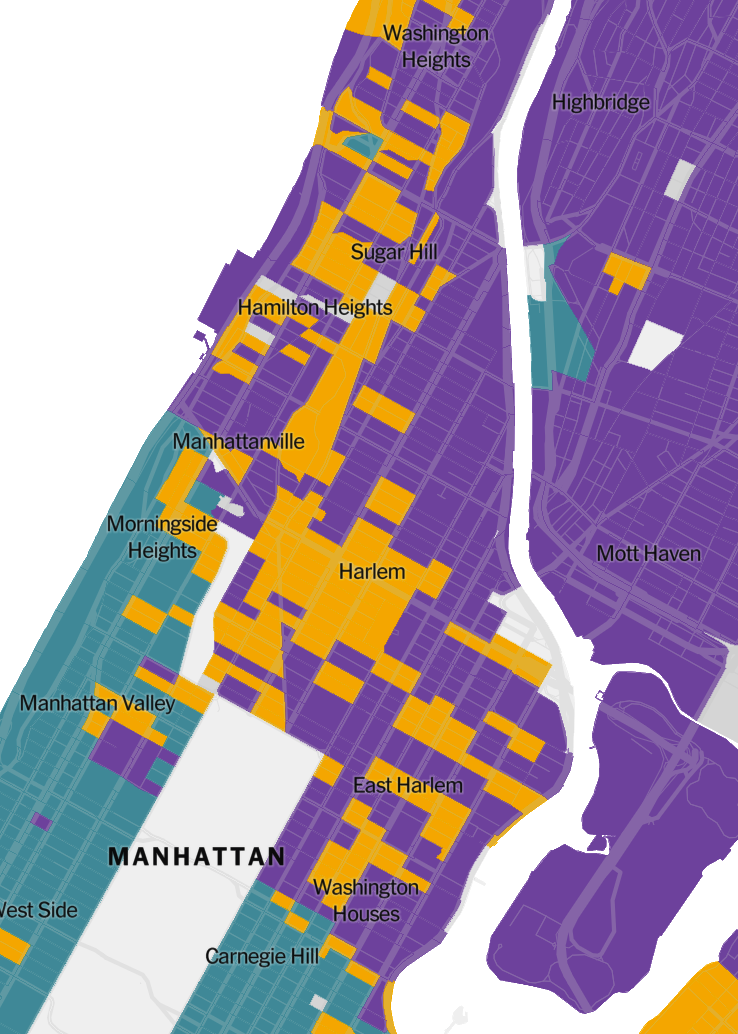
Wealthy Manhattanites went for Garcia, the administrator. Wiley made a strong showing in Harlem, though Adams did better there. The South Bronx, one of the poorest, highest-risk-of-violence places in New York City? Adams, the former policeman promising more and better policing, swept it.
Similar patterns show up all over the map. If you're familiar with New York's layout, it's well worth playing around with it.
In other words: The people in the most heavily policed parts of the city, the ones in whose names reformers often claim to speak, voted for more policing rather than fundamental overhaul of policing. (At least, that's how it looks to me!)
What's the strongest abolitionist reply that can be made to evidence like this? To be sure, there is a vocal and very engaged subset of residents in heavily policed neighborhoods who do favor abolition. Maybe that group is right. But that group is also a minority among its neighbors. I wouldn't want to defend the claim that woke activists, with their (our?) elite college pedigrees and social media habits, somehow know better than the people actually living in these neighborhoods do what they need. And yet, an argument somewhere close to that seems necessary here. Perhaps one might say that the activists within these communities – even if they don't yet have the numbers – do have the moral high ground and therefore deserve the massive policy subsidy that they effectively receive via philanthropic support of progressive policy advocacy.
What does all this have to do with stories?
Only that I don't think everyone – or maybe anyone – can tell all sides of a story at the same time. Maybe, like lawyers who know all sides of case yet speak only for one side, we need to recognize that each story is itself a kind of side-taking, a controversial and debatable point of view about what matters and how things fit together.
In other words, the work a story does and the work that a Gallup survey does are different in kind. The survey treats everyone's point of view as equally valid; the story, by its essence, cannot.
It's enough to make me want to hold stories at arm's length.